Time and Again, When Warned About the Covid Shots, Fauci Looked Away
His diary records the warnings arriving from the FDA, the CDC, Oxford, and the man who invented the rotavirus vaccine. It also records him seeing them as annoyances.

In August 2021, Paul Offit told Anthony Fauci that the booster campaign had gotten ahead of the evidence.
Offit is one of the vaccine industry’s biggest cheerleaders. He co-invented the rotavirus vaccine. He sits on the FDA advisory committee that votes on these products. Offit telling Fauci he’s moving too fast is like Mike Tyson having warned Tupac he needed to dial it back.
Here’s Fauci’s diary entry, in full, on the substance of that warning:
“The boosters are safe and to put it in plain terms it can help, and it certainly cannot hurt.“ (p. 856)
It certainly cannot hurt. Not “the benefits outweigh the risks.” Not “we’re monitoring.” A flat declaration that a medical intervention has no downside — written privately, to himself, by the government’s chief infectious disease official, in the same entry recording that one of the most respected vaccine scientists in America had just told him to wait for more data.
The three moves
Read all 1,141 pages and a pattern emerges: Whenever a safety concern reaches Fauci, he does one of three things.
He impugns the motive. April 2021: Oxford researchers publish a large database analysis finding more thrombosis with the mRNA shots than with AstraZeneca’s. Fauci’s entry, same day:
“Obviously, bullshit. They did not look for thrombocytopenia and so the observation is invalid. Also, not surprising fr the Oxford group sine their vaccine is in trouble and I would not be surprised if they were trying to disparage the other vaccines.“ (p. 692)
As he often does, Fauci appears more focused on the business of vaccines than the science.
He asserts privileged data. September 2021, on the outside physicians raising questions:
“The talking head docs on the outside all have their own opinion, many of whom have not seen the data that we have seen.“ (p. 874)
And he reframes the concern as an obstacle. This one is even more revealing. Briefing Biden and Harris on the booster rollout, Fauci writes:
“we needed to do this and make sure that we don’t have a stumbling block with the FDA and acip. The one issue that could arise is that the risk benefit ratio of boosting young kids 18 years old and there abouts may not be favorable in the context of the risk of myocarditis balanced against the risk of their winding up in the hospital.” (p. 852)
For Fauci, a federal safety review is not a group of experts whose opinion to respect, if an obstacle to be overcome. He freely admits an unfavorable risk-benefit ratio for teenagers is the thing that “could arise.”
Early warnings
The dismissals started before there was a vaccine to defend. In April 2020, at a task force meeting on the government’s vaccine strategy, Deborah Birx — the White House Coronavirus Response Coordinator, a physician with 30 years in vaccine research — tore the plan apart. Part of her objection was about the technology itself. Fauci’s diary: “She does not like ‘newer technology’ such as mRNA, DNA, and even some viral vectors. She likes antigens, whole killed, etc.” Then his verdict, in five words: “A bit overdetermined in her prejudice” (p. 68). That was April 29, 2020. Again, a seasoned scientist on his side of the vaccine debate is being swept aside, seemingly for having different views than Fauci.
September 2020, before any vaccine was authorized: A volunteer in the Oxford-AstraZeneca trial developed transverse myelitis — inflammation of the spinal cord, a serious neurological injury. The trial was halted worldwide. Fauci’s entry: “Lot of discussion about the transverse myelitis in a volunteer in the UK Chimp Ad Oxford trial. May have had a prior case, but was designated as multiple sclerosis” (p. 352). Within a sentence of recording the injury, he had somehow managed to internally diagnose the patient he’d never examined with a pre-existing condition. The trial resumed in Britain that month. It stayed paused in the United States for another six weeks, because American regulators wanted to see more.
On December 17, 2020 — five days after the first American shots went into arms — Fauci had a call with Chris Whitty and Patrick Vallance, Britain’s chief medical officer and chief scientific adviser. They had a warning: “the UK is seeing more than just the two instances of anaphylactic reactions to the mRNA vaccine of Pfizer” (p. 539). Their country had started vaccinating a week ahead of ours, which made them the world’s early-warning system, and they were sending him a a warning. Fauci recorded it as a bullet point between a note on case surges and a note on the Moderna authorization. He never came back to it.
What he was told, and by whom
The warnings weren’t fringe, either. They came from inside the building.
The FDA’s two top vaccine regulators quit over it. Marion Gruber and Phil Krause, director and deputy director of the office that reviews these products, resigned in August 2021. Fauci recorded the reason accurately — “they are upset that decisions have been made by acip and by the White House that should have been made first at the level of the FDA” (p. 864). He called it “a big blow to the FDA.” He never once seemed to seriously consider whether they were right.
Then they published in The Lancet, with WHO scientists, concluding the evidence didn’t support boosting the general population. Fauci’s verdict: “This is clearly sour grapes on the part of the FDA who feel that they are being pressured to approve boosters“ (p. 872). Elsewhere he wrote they “were actually shooting from the hip without knowing anything about the Israeli data.”
The Israeli waning data became Fauci’s trump card in the booster fight. In July 2021, comparing notes with British counterparts, he wrote that they were “skeptical about the Israeli vaccine efficacy data for asymptomatic and mildly symptomatic disease as we are here in the United States” (p. 817). As we are here in the United States. Two months later the same data was solid enough to override the CDC’s advisory committee at 5:40 in the morning. In Fauci World, the same study was contested when it argued against boosters, he decisive when it argued for them.
Gruber and Krause weren’t the first to quit in protest. In May 2020, Peter Marks — the director of the FDA center that reviews every vaccine in America, and the man who named Operation Warp Speed — quit the program. Fauci gave it eleven words: “Turmoil in OWS – Peter Marks drops out. Upset with how he is being treated with the arrival of Moncef” (p. 187). The next sentence of that entry is about Trump’s re-election prospects. Three of the most senior vaccine regulators in the federal government left their posts over how these products were being handled. Fauci logged all three departures, but never once whether they might have had a point.
The CDC’s own staff flagged the safety gap. From his September 2021 entry: there is “a lack of a lot of data for safety among young individuals particularly in the context of myocarditis,” and CDC’s Amanda Fine “was very concerned that the ACIP would balk at recommending for younger individuals the third dose because there was not enough safety data“ (p. 873).
His next line in that same passage: “As we all know Jeff is very much intense on getting this approval through.”
And when the CDC’s advisory committee voted 9–6 against, on exactly those grounds, Fauci started working the phones. He texted Rochelle Walensky and — his word — “literally begged her to override“ the vote (p. 883). She called back at 11:25 that night. He missed it. They spoke at 5:40 the next morning. She reversed her own experts. Fauci congratulated her on finally showing “clear leadership,” and noted she’d acted “based on very intensive persuasion that I made to her late at night“ (p. 887).
By that November, he had a name for the committee’s caution: “an overly concerned attitude about myocarditis in the younger male age group“ (p. 917).
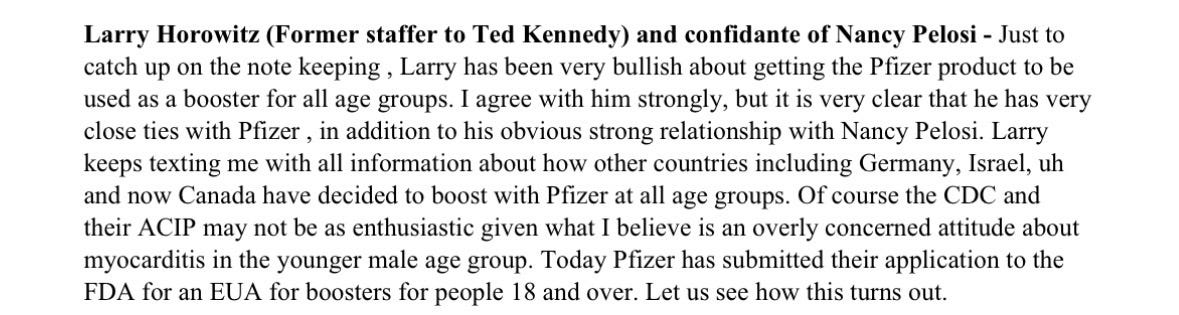
In the same passage, he mentions the ally who kept texting him foreign booster data — and observes, without a flicker of discomfort, that the man “has very close ties with Pfizer.”
Six deaths, then the Daily Mail
April 12, 2021. Walensky calls at 10 p.m. about the Johnson & Johnson pause. Fauci records the details: six cases of cerebral venous sinus thrombosis. All women, 18 to 48. One dead. Three hospitalized, two in intensive care. Onset six to 13 days after the shot. (Thrombosis is the same warning he dismissed from Oxford.)
The next line of the entry is about a Daily Mail article concerning his old high school (p. 689).
No reflection, follow-up — nowhere in 1,141 pages does he attempt to look into the issue further
Zero
Here is the count across the entire diary of the man who ran America’s vaccine messaging.
Times he writes “VAERS” — the federal adverse event reporting system: zero.
Times he writes “safety signal”: zero.
Times he writes “adverse event” about a vaccine: zero.
“Risk-benefit,” as a phrase he uses to think with rather than a hurdle to clear: zero.
He wrote 641 separate entries logging his own press appearances.
He used to know better
None of this is because Fauci didn’t understand the risks. He understood them perfectly, and the diary proves it — because in March 2020 he was the one applying the brake.
When Trump’s people wanted remdesivir rushed to the public, Fauci put his objection in writing to the White House. He had “more concern about the potential toxicities of this unapproved, investigational drug in the context of COVID-19 as well as the need to prove that it works before we widely distribute it“ (p. 726).
That’s the correct instinct, expressed clearly.
Yet 18 months later the same man was calling an advisory committee’s safety caution “overly concerned,” disposing of a thrombosis paper in a single day, taking pre-announcement phone calls from Pfizer’s CEO, and telling his diary that a booster “certainly cannot hurt.”
Had only he attempted to verify that’s true.
All citations refer to Anthony Fauci’s personal diary, 1,141 pages, released by Sen. Rand Paul on July 24, 2026, and available at paul.senate.gov. Word counts are raw string searches of the extracted text.